
4 May 2026
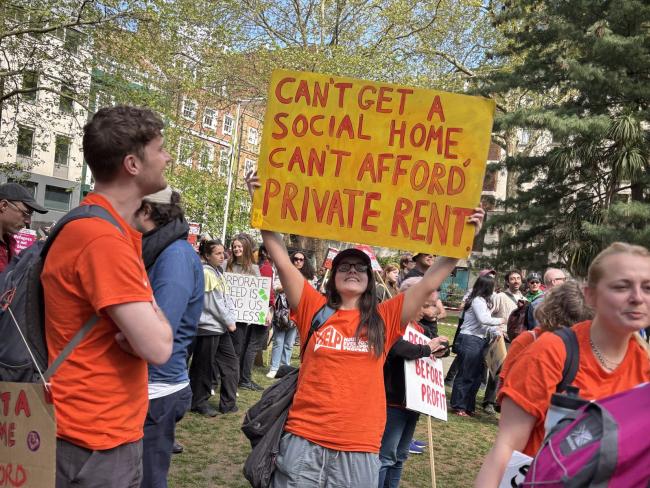
The message is clear. Housing march and rally, London, 18 April 2026. Photo Workers.
The housing crisis across Britain isn’t going away despite new legislation on renters’ rights. A demonstration last month in London carried the message that much more needs to be done.
After years of campaigning, the law changed on 1 May 2026 to end “no fault” evictions at the whim of private landlords. The Renters’ Rights Act 2025 also provides for a degree of security and some limits on rent increases. These changes are significant, but only deal with some aspects of the housing problem.
Failure
A national rally and march through central London on 18 April highlighted the failure of the Starmer government to address a host of other outstanding housing issues.
Supported by trade unions Unite and Unison, residents of London boroughs – families with young children, students, pensioners and campaign groups – joined with renters’ organisations from cities such as Bristol, Portsmouth, Sheffield and Manchester.
‘They came to tell those in power to refurbish empty homes…and much more.’
They came to tell those in power: to refurbish and allocate the homes lying empty (a million in England alone); to build the promised quota of affordable homes (130,000 uncompleted at the last count); to provide security of tenure for renters by building more social housing; to protect local traders on high streets such as the historic Old Kent Road from developers; and to call for building safety standards to be fully implemented following the Grenfell Tower fire in 2017.
Whatever is done to improve private renting, social housing is key. This has declined dramatically since the 1980s Thatcher government introduced “right to buy” for council tenants: it still exists in England, though now abolished in Scotland and Wales.
Security
Without access to social housing there is no lasting security for renters. Even well-meaning private landlords can reclaim their property for personal use, without responsibility for rehousing.
Well-founded anecdotal evidence reported in the media asserted that during the months leading up to 1 May some unscrupulous landlords rushed to evict tenants while they still could. Some put up the rent, forcing renters out, before controls came in under the new Act.

This will add to the already great burden on local authorities. Shelter says that 90,000 new social homes are needed each year in England alone for the next ten years.
Anger
Anger was especially directed at the Labour government for allowing the loophole whereby developers use “viability assessments” (estimates of unrealised profits) to reduce the number of affordable homes they were originally contracted to build.
Protesters also pointed to the demolition of well-built existing homes capable of refurbishment. Occupants are often displaced to make way either for luxury redevelopment, or for council “shoe boxes”, abandoning traditional standards on living space.
Pressure
The government will claim credit for helping renters. But the Act was set in motion before the present government was elected: Labour simply promised in its manifesto to enact it. Without workers’ pressure it is likely to have gone the way of other broken promises. And as the gathering in London set out, there’s a continuing need for such pressure.