
25 March 2026
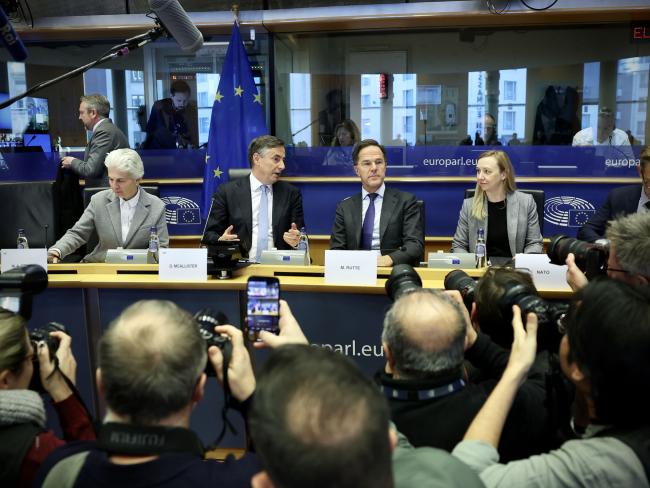
EU and NATO work together, always. NATO Secretary General Mark Rutte at the European Parliament in Brussels, 13 January 2025. Photo NATO via Flickr (CC BY-NC-ND 2.0).
The EU has long been preparing for war, even before the US bombing of Iran. This takes the form of increased military spending by member states – but also increasing EU control under the guise of “coordination”.
In March 2025, the European Commission President Ursula von der Leyen proclaimed “ReArm Europe” – a strategic initiative to boost “defence” spending. Later renamed “Readiness 2030”, the plan pledges the EU to spend up to 800 billion euros, with support for the war in Ukraine high on the agenda.
Military spending up
Shortly after, in September 2025, the EU announced “Security Action for Europe” (SAFE). This scheme, one element of the wider strategy, is designed to enable member states to expand military spending.
The EU will raise 150 billion euros from international private capital markets under the SAFE plan for onward lending to members. The loans are described as “temporary”, but will be repaid over 45 years. But that’s only the start.
‘The workers of EU countries will pay rearmament costs, which will be extremely expensive.’
The EU had already indicated that it would allow member states to increase military spending without regard to the normal budget deficit rules. The workers of EU member countries will have to pay the costs – the interest on those loans and the rest of the rearmament programme, which will be extremely expensive.
Unsurprisingly, this is not proving to be popular. On 12 March the Polish president Karol Nawrocki vetoed a law that would have enabled the government to tap 44 billion euros from the SAFE scheme.
Profits
Poland was set to be the largest beneficiary of the SAFE scheme. Nawrocki said that the EU should not control Poland’s military spending. He called SAFE “a massive foreign loan for 45 years in a foreign currency, with interest costs that could reach up to 180 billion zlotys [48 billion euros]. Poles will therefore have to pay back twice the value of the loan, and Western banks and financial institutions will profit from it.”
He also framed the decision in terms of sovereignty saying, “I will not sign a bill that undermines our sovereignty, our independence, as well as our economic and military security.”
Undeterred
But EU supporters of war are not easily deterred. The president’s veto may not end Poland’s participation in the scheme. Their prime minister Donald Tusk, a former president of the European Council, said that his cabinet was preparing a “plan B” that would let Poland access the EU funds through alternative legal or administrative mechanisms.
‘The arms industry backed the EU scheme.’
The arms industry – both its state-owned and its private segments – backed the EU scheme. So did much of the military establishment. In Poland, the Chief of the General Staff General Wieslaw Kukula and Armaments Agency head General Artur Kuptel both publicly backed it.
The EU uses other ways to advance its role as an arm of NATO. Last November, the EU introduced the Military Mobility Package, designed to speed up the free movement of military assets and personnel across Europe’s borders.
European army
This is another step towards a European army, despite likely opposition to doing so overtly. The EU tries to frame US actions and declarations about the future of NATO by President Trump as justification for its aims. Not everyone is buying this.
Before leaving the EU, the British government was against the idea of a European army. Starmer’s government is calling for closer defence and security co-operation with the EU. That means in effect going along with the EU strategy, despite being “locked out” of SAFE.