
20 May 2026
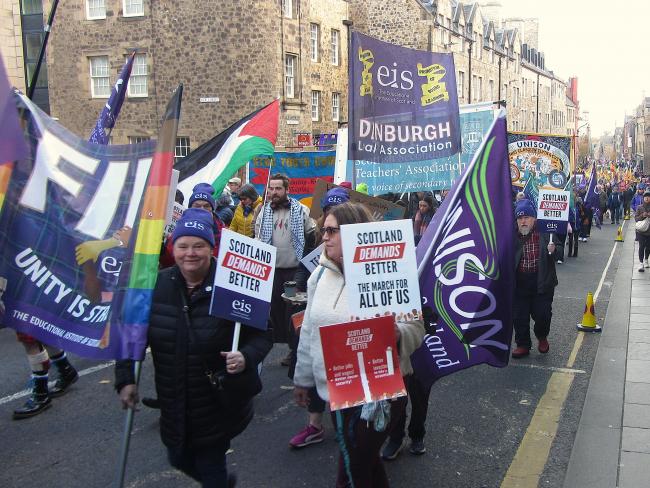
Education workers and many others taking part in the Scottish TUC march, Edinburgh, 25 October 2025. Photo Workers.
The elections on 7 May marked rejection of the Labour government across Britain. Workers in Scotland and Wales have also to deal with their devolved administrations. Newly-elected maybe, but without anything new to offer.
The workers of Scotland voted for a united Britain in 2014. And as with the 2016 Leave vote, politicians of all sorts tried to undermine it. And since then, the Scottish National Party has presided over a rapid decline, almost without parliamentary challenge.
Divisive
Watch out now for the actions of the SNP – who would surely have done even worse on 7 May but for the lamentable UK government.
‘The Holyrood vote saw a healthy majority for pro-union parties.’
They will return to the divisive aim of “independence” (inside the EU) rather than putting right the many devolved matters they are responsible for and which they have mis-managed.
In fact, the vote for Holyrood resulted in a healthy majority of votes for pro-union parties – 54 per cent of those voting in the regional vote, as against 43 per cent for separatist parties. Notably turnout was down from 63 per cent in 2021 to 53 per cent this time.
Rejection
In Wales, the working class finally and thoroughly rejected the Welsh Labour Party – in office for years but no less damaging than the SNP.

Turnout was higher than previous elections – but still only around 50 per cent. The new administration is as likely to fail them as Labour has (and as the SNP has failed Scottish workers).
British governments and their separatist franchisees are a double act performing on behalf of the EU. They represent the opposite of independence.
Prevention
Promoting a return to the EU (or adopting EU rules without membership) or breakaways by Scotland or Wales follows a similar path seen in other countries.
The objective is to create hopeless division and aimless anarchy to prevent the working class grasping the challenge to take control of their own destiny.
The uniting factor for workers across the whole of Britain is that which led to the various votes – rejection of the current path and a distrust of those in office.
• Related article Elections bring no change.