
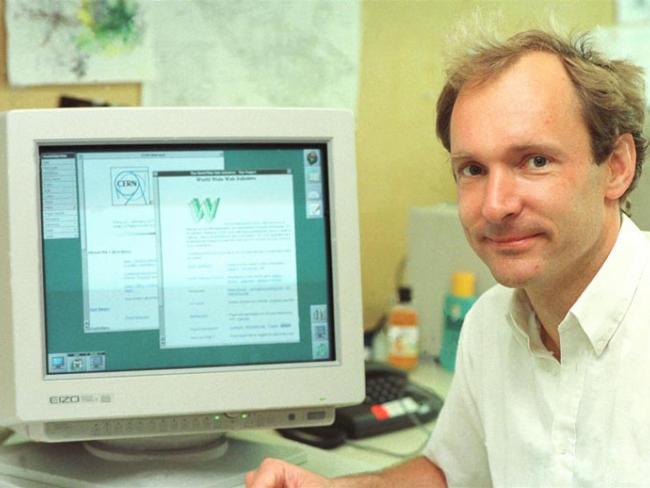
Tim Berners–Lee at his desk at CERN, 1984. Photo CERN.
The modern world would be unthinkable without the World Wide Web – invented in a physics laboratory and made available to the world for free…
This is for everyone: the captivating memoir from the inventor of the World Wide Web, by Tim Berners-Lee, hardback, 389 pages, ISBN 978-1035023677, Macmillan, 2025, £25. eBook and Kindle editions available. Paperback edition due out 3 September 2026.
Tim Berners-Lee invented the world wide web. His fascinating book spells out the opportunities it offers, and the threats which could sabotage them.
He writes, “In the early days of the web, I put my design tools in the hands of individuals, not administrators or corporations primarily motivated by profit. This was one of the best decisions I ever made.”
At that time the web belonged to CERN, the joint European particle physics lab in Geneva. If someone above Berners-Lee’s pay grade there had a mind to, they could probably have started charging to use it.
“The only way forward, I realized, was to donate the intellectual property behind the web to the public domain. I had never intended to profit personally from the technical protocols I’d written for the web, so this decision didn’t impact me – and it didn’t matter. For the web to succeed, it had to be free.”
Berners-Lee always knew that the profit motive and possible monopolies might corrupt what he was trying to build.
For anyone to use
So, on 30 April 1993, CERN published the complete source code to his protocols, client and web server software, relinquishing all intellectual property rights, and gave permission to anyone to use, duplicate, modify and distribute it.
Phone technology has revolutionised communications. After about 13 years the web had a billion users. There were two billion smartphones two years after they became available.
And now, a few providers have become dominant, unregulated monopolies. Facebook, Instagram, YouTube, TikTok and X – each is a variation on the same concept, delivering media in an endless feed of algorithmically managed addictive content.
These new channels have pushed aside the open space for collaboration and experimentation that defined the web through its first twenty years.
The main obstacle facing the web is the power concentration among a few major sites. In the web, like everywhere else, capitalism’s invisible hand of competition does not work. We need an inclusive hand that lets everyone benefit from AI.
Apple took a 30 per cent commission of the apps it sold, and continuing income from subscriptions and in-app purchases. It was far more profitable for Apple to direct developers to build an app than to build a mobile website. Apple got a cut from the former, nothing from the latter.
Providers guide users into the app ecosystem. The toll booths the web had managed to avoid on the PC found their way into the mobile realm. The Apple Store was exactly the kind of for-profit gatekeeping that Berners-Lee had always hoped the web could navigate around.
Yet the web powers most of the apps on our mobile phones and delivers much of their content to them. It powers videoconferencing, augmented reality and AI, whose potential and impact are only just starting to be understood. AI needs data to train on, mostly sourced from the web.
“The only way forward, I realized, was to donate the intellectual property behind the web to the public domain…”
The app marketplace has not replaced the web. The mobile apps were superseding the browser, but the infrastructure that serves the content to these apps still runs on hypertext transfer protocol (HTTP) – the foundational set of rules that dictates how data (like text, images, and video) is requested and transmitted across the web.
Apps like X, Instagram, YouTube and TikTok all use HTTP to retrieve content. The web is still there, running behind the scenes.
Social media companies use machine-learning techniques to make users addicted to their platforms, feeding people more and more extreme content. We need to regulate the addictive algorithms, the ones that guide people into rabbit holes.
Berners-Lee believes that we should legislate to control “hostile activism” – harassing people online, intentionally spreading disinformation, and threatening or even committing violence.
The addictive forms of social media have morphed into something misleading, toxic and habit-forming. Too many governments now use the web to spread disinformation and surveil their own citizens. Most web traffic is now concentrated in a few large platforms which harvest private data and share it with commercial brokers and repressive governments.
Instead we should work towards the ideal of data sovereignty – that you, not Facebook and so on, should own your profile and your history of interactions. We have to build tools and systems that empower individuals once again.
Control
Berners-Lee has developed a system called the social linked data protocol, or Solid for short. It permits users to take control over all the data in their lives and use it to achieve new results.
As he sums up, we can restore the web as a tool for collaboration, creativity and compassion across cultural borders. We need web agents to serve people, not corporate profits, not governments. Combining collaboration and creativity “could reach a new state of intellectual production I termed ‘intercreativity’: the ability of a group of people to be creative.”
A remarkable book, by a truly remarkable man. By his sheer moral and intellectual integrity, he lines up with the working class, the force of progress. All his working life he has had to struggle to keep his achievements out of the clutches of those enemies of progress who would grab everything good and useful into their own hands, for profit. Hence the huge significance of his work and ambitions.