
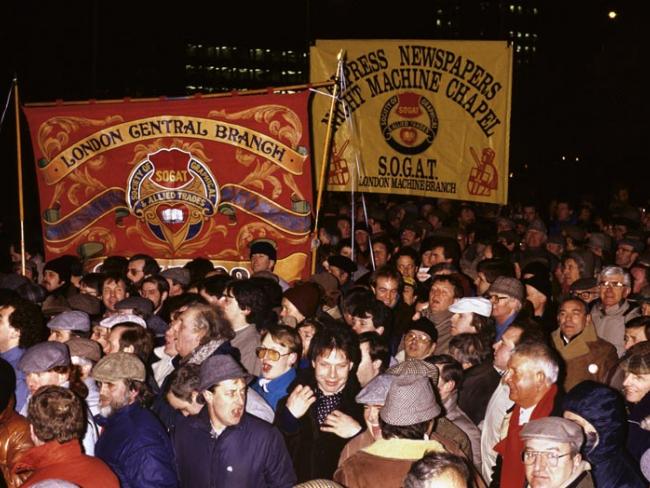
Mass picket, Wapping, 13 February 1986. Photo John Sturrock/Alamy Stock Photo.
Forty years ago an epic industrial dispute erupted in national newspapers when an entire workforce was sacked to boost a print magnate’s profits…
In January 1986 some 6,000 print union members – not just printers, but secretaries, advertising workers, engineers, just about everyone – working for News International walked out on strike. And were immediately dismissed.
The story may seem strange to modern readers. It involves an industry that is unrecognisable now, unions that no longer exist, skills that have disappeared. But along with the miners’ strike of 1984/1985, it came to epitomise an era in which workers discovered that under capitalism gains can only ever be temporary. Even, or perhaps especially, in the best organised workplaces.
The fight took place at News International, publishers of The Sun, The News of the World, The Times and The Sunday Times, accounting for some 40 per cent of all newspapers sold in Britain.
The strength of the print unions was legendary, and linked to the production process. Newspapers needed to be in readers’ hands when they went to work in the morning. Delaying production by just a few hours could wreak havoc.
Print workers zealously guarded their own trades. If a journalist, for example, even touched the “stone”, the lead block that would form a page of newsprint, it could spark an industrial dispute.
Employers put up with this union power because they had to. But the advent of new technology opened up the possibility of circumventing the unions.
With unions organised throughout the chain of production and distribution, the task seemed too difficult for employers to contemplate. The unions themselves were confident that it couldn’t be done. They were wrong, very wrong.
Employers hated having to go cap in hand to the unions every time they wanted to change something, and none more so than the owner of News International, the Australian mogul Rupert Murdoch. He set out to destroy the power of the print unions.
The first stage of the plot involved setting up a plant at Wapping, done with the tightest security. The unions never even got in to take a look. Murdoch said that it would produce a newspaper called the London Post. That was a fiction, but enough to put the print unions off the scent.
Plotted
Next Murdoch plotted to dispense with his troublesome production workforce and replace them with workers who were more flexible, more malleable. This he did in collaboration with the Electrical, Electronic, & Telecommunications and Plumbing Trade Union, the EETPU. Hundreds of workers were recruited and secretly trained in Wapping, east London, and Kinning Park, Glasgow.
Money was an issue, of course. According to some estimates, simply sacking the workforce would cost some £40 million (more than £100 million at today’s prices). Lawyers had already advised News International that the cheapest and simplest way of dispensing with the unionised workforce was to sack them while they were on strike. That would involve no justification, and no redundancy payments.
The strike was precipitated when News International management made the unions an offer they couldn’t accept, including the end of the closed shop (whereby only union members could be employed), flexible working and a no-strike clause.
‘The police had been forewarned and had prepared to clamp down on mass picketing…’
When the unions, predictably, went on strike, News International was ready. The unions had walked into the trap. Dismissal letters had already been printed – as recommended by the lawyers – and were handed to workers on 24 January 1986 as they came off shift for the last time.
News International had meticulously prepared for the dispute. Distribution, formerly done via rail and vulnerable to secondary action by rail unions, was switched overnight to a fleet of non-unionised TNT vans.
The police, too, had been forewarned and had prepared to clamp down on the mass picketing that took place for months. The Highway, the main road outside the Wapping plant, saw police horses in action evening after evening as pickets sought to stop lorries laden with newspapers leaving.
Refuseniks
Importantly, the majority of journalists, though urged by their union not to cross picket lines, did so. Without them, Murdoch would have found it hard to produce papers worth buying, at least in the short term. A brave minority held out, and were labelled “refuseniks”.
The dispute ended after a year. The print union SOGAT, Society of Graphical and Allied Trades, admitted defeat. It ceased picketing on 5 February 1987.
The landscape of newspaper publishing had been changed. Fleet Street as the embodiment of national newspapers no longer exists. Nor do the print unions. SOGAT and the National Graphical Association first merged together, then folded into Unite. Even the EETPU disappeared, merging first into the Amalgamated Engineering Union, then, also, into Unite.
The newspapers themselves have seen their print circulations plummet – in the early 1980s The Sun was selling 3 million copies a day. Now its circulation is estimated at around 550,000. The News of the World, which was selling 4.6 million copies every Sunday, has disappeared (it was closed in 2011 following the hacking scandal). Its successor, the Sun on Sunday, sells about 500,000 copies.
Independent trade unions are still not recognised by News UK, as News International is now known. In the latest attempt, the National Union of Journalists was told in May 2025 that it could not be recognised because the company had concluded a recognition agreement with the so-called News Union – which is 96 per cent funded by News UK and has been unable to obtain certification as an independent body.
• Correction: This article now states the correct date for the miners’ strike, 1984/1985, it originally said 1983/1984, as does the printed edition.