
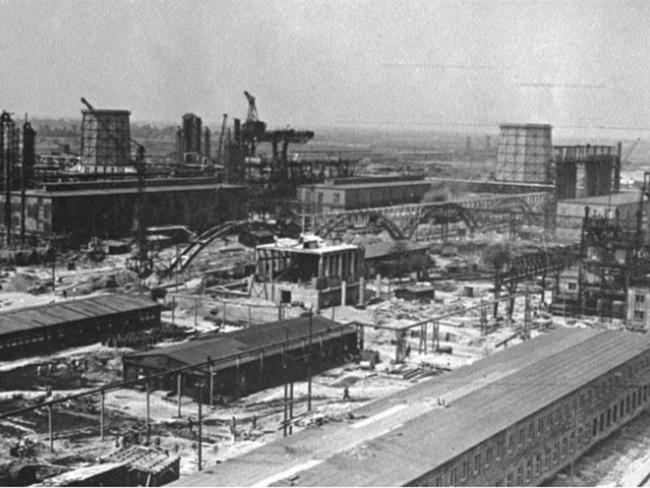
The IG Farben works by Auschwitz concentration camp. The largest artificial rubber and synthetic oil plant in the world, it ran on slave labour – for which IG Farben paid a fee per worker directly to the SS. Photo Bundesarchiv, Bild 146-2007-0058 / CC-BY-SA 3.0.
With chancellor Rachel Reeves looking around for funds to prepare for war, it’s instructive to see how the Nazis approached the problem…
It was August 1936, the month of the Berlin Olympics. But Adolf Hitler, Germany’s chancellor, had other things than sport on his mind. He was drafting a memo on the economic situation that would swiftly put the country on the road to war.
Hitler set two tasks: the German army had to be ready for war in four years; and the economy had to be ready for war in four years.
One immediate consequence was the creation of the Four-Year Plan, under the direction of Herman Göring, with the sole object of preparing Germany for war. That began in the autumn of 1936, with the country’s largest company, IG Farben, leading its implementation.
Indeed, most of the ideas in Hitler’s plan had come directly from IG Farben, written by one of its directors, Karl Krauch, who had been appointed an adviser to Göring in 1935. Krauch would go on to be crucial to the implementation of the Four-Year Plan.
Hitler had singled out the production of artificial fuel and artificial rubber. IG Farben obliged, by among other things later building the world’s largest artificial rubber factory at Auschwitz. It would run on the back of 80,000 slave labourers housed in a section of the concentration camp.
Secrecy
The massive investment needed to put Germany on a war footing needed money. And Germany was short of money. Its currency reserves were depleted, gold too. More importantly, it was crucial not to alert the world to what the Nazis were doing.
The solution was already in place, courtesy of Hjalmar Schacht. He was chosen by Hitler in 1933 to be president of Germany’s central bank, the Reichsbank. He created a dummy company – the Metallurgische Gesellschaft, or Mefo for short.
‘Hitler had already decided how Germany was going to pay for the bills: by a war of conquest and expropriation…’
Schacht had been president of the Reichsbank before, between 1923 and 1930, but had been dismissed. Now he was returning in triumph. Within weeks, the ingenious solution to Germany’s pressing financial woes would burst forth from his inventive brain.
“It was necessary,” Schacht later explained, “to discover a method that would avoid inflating the investment holdings of the Reichsbank immoderately and consequently increasing the circulation of money excessively.”
“Therefore,” he went on, “I had to find some means of getting the sums that were lying idle in pockets and banks, without meaning for it to be long term and without having it undergo the risk of depreciation. That was the reasoning behind the Mefo bonds.”
With a startup capitalisation of one billion marks – which Hitler and Schacht arranged to be provided by the four giant firms of Krupp, Siemens, Deutsche Werke and Rheinmetall – this company would eventually promote many billions of marks worth of investment.
Enterprises, old and new, that filled government orders had only to draw drafts on Mefo for the amounts due. These drafts, when presented to the Reichsbank, were immediately convertible into cash.
The success of the Mefo program depended entirely on public acceptance of the Mefo bonds. But the wily Schacht had planned well. Since Mefo bonds were short-term bonds that could be cashed in at any time, there was no real risk in buying, accepting or holding them.
They bore an interest of 4 per cent – a quite acceptable figure in those days – whereas banknotes hidden under the mattress earned nothing. The public quickly took all this into consideration and eagerly accepted the bonds.
While the Reichsbank was able to offer from its own treasury a relatively insignificant 150 million marks for Hitler’s war on unemployment, in just four years the German public subscribed more than 12 billion marks worth of Mefo bonds.
These billions, the fruit of the combined imagination, ingenuity and astuteness of Hitler and Schacht, swept away the temporising and fearful conservatism of the bankers. Over the next four years, this enormous credit reserve would make miracles possible.
Rearmament
By 1939, 23 per cent of Germany’s GDP was going on rearmament. For comparison, Britain’s armaments expenditure is currently running at 2.4 per cent.
Sooner or later, the bills would have to be redeemed. But the government had continued extending the redemption deadlines, all the way up to 1939. Hitler sacked Schacht in January 1939. By then Schacht – not a Nazi and never allowed a say in matters of politics – had done his job.
Schacht had become worried that too much money was going to rearmament and that his Mefo bills were causing
inflation. Hitler had no such worries. He had already decided how Germany was going to pay for the bills: by a war of conquest and expropriation.
When Germany took over Czechoslovakia in March 1939, not even two months after Schacht’s dismissal, German companies quickly looted the country’s resources. In fact, weeks before the 1938 Munich Agreement which carved up Czechoslovakia and laid the groundwork for the subsequent invasion, IG Farben had negotiated a takeover of its largest dyeworks, the Aussiger Verein.
As the Nazi war machine rolled into action across Europe, Hitler issued decrees on the seizure of property, later presented in the Nuremberg Trials.
A war of conquest might seem to be beyond the abilities of the British ruling class. But it never does to underestimate the depth of their ambitions.
Massive borrowing – a feature of government policies for decades – has to be paid for at some point, somehow.