
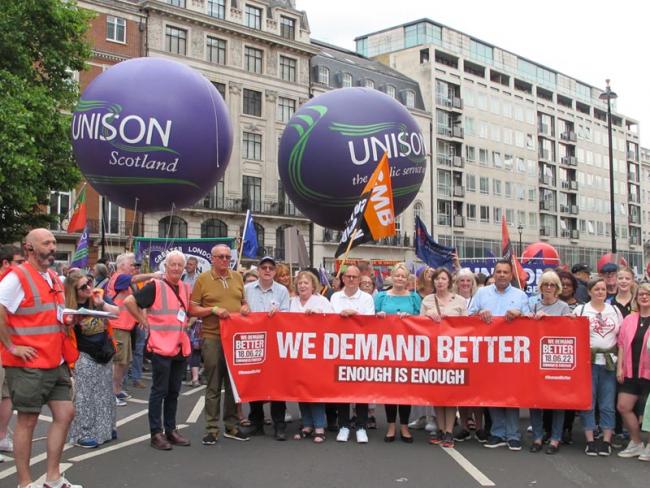
TUC march, London, June 2022. Better is not enough. Britain needs a completely new approach to the economy. Photo Workers.
It is evident to all workers, and many capitalists, that Britain is experiencing a worsening decline in the economy, unable to provide the jobs, goods and services people need. But that observation on its own will not lead to change…
It is clear, or it should be, that the present government does not know what to do about the decline. And nor did any of its predecessors. As communists, the CPBML argues that no tinkering with parliamentary government is going to ultimately solve the problem.
We say there will be no progress, or even a halt to the decline, unless the people of Britain – the working class – start to take control and make decisions about how the economy is run. That’s a bold assertion, but the alternative is a repetition of failed policies and further decline.
In discussions about alternatives to capitalism, you often hear that socialism is “alright in theory but doesn’t work in practice”, followed by “how will you do it, then?” It’s a reasonable question at one level but at another it assumes that someone else has the answer – and that’s the heart of the problem for the working class.
If British workers rely on others to solve the problems of our nation, surrendering control and responsibility to those who do not share our interests, we will end up with answers that suit them and not us.
At present that means: deindustrialisation, uncontrolled migration, net zero, returning to the EU and preparing for war. The results are: a loss of jobs, especially skilled jobs; fewer opportunities for young workers; inadequate public services and so on.
Capitalism does not meet people’s needs, so how to change that? How do workers, the vast majority and the creators of wealth, set about reversing decline?
To think about solutions it is useful to look back to see how we arrived here. Events in the latter half of the nineteenth century can shed some light on that. The problem of shaking off reliance on others, and instead thinking about how workers can take control, isn’t new.
The title character in George Eliot’s novel Felix Holt, The Radical, written in 1866, says, “I should like to convince you that votes would never give you political power worth having while things are as they are now, and that if you go the right way to work you may get power sooner without votes.”
Servile
The novel brings to life the electoral discussions of the time, using a range of subtleties that unmask servile thinking. When the novel was written, the leaders in parliament, Disraeli and Gladstone, were falling over themselves to extend the vote.
In 1867, the number of men eligible to vote doubled to 2 million. But 5 million men and all women were still excluded; it was many decades before all workers had the vote.
The subsequent election in 1868 saw the new working class electorate overwhelmingly vote for a Liberal government headed by Gladstone. From 1900 onwards the Labour Party gradually took those votes, but just like the Liberal party it always wished to be part of the ruling apparatus, never challenging it.
For the previous two decades, Karl Marx, a leader in the emerging workers’ political movement, had been living and working in Britain. During the 1860s he published key works – including Wages, Price and Profit (presented to the International Working Men’s Association in London in 1865), and the first volume of Capital in 1867.
‘Capitalists were quick to sense the threat from Marx’s analysis of surplus value…’
Capitalists had previously lauded the economic analysis of labour time and value by early economists like Adam Smith (1723-1790) and David Ricardo (1772-1823). But they were quick to sense the threat from Marx’s analysis of surplus value – the portion of labour that capitalists extract from workers.
They sought to create popular economic theories that rejected the labour theory of value, that masked over it, or pretended it doesn’t exist. Many such theories, all in the interests of capitalism, have come along since.
Arguably the most enduring is the “factors of production”. This can be summarised as: rent to the landowner; interest to the financier; profit to the manufacturer; and wages to the labourer.
Where has value gone?
According to this outlook each group has a contending claim on the distribution of revenue derived from industry and commerce. In every economic textbook, surplus value has disappeared, replaced by “factors of production”.
This concept completely and deliberately ignores that labour power alone is the sole creator of surplus value which is then distributed as revenue in the form of rent, interest and profit, with as little as possible going to wages.
From 1865 onwards the development of this political and economic falsehood in Britain has proved difficult for workers to shake off. It provides comfort to those who want to see capitalism continue or who fear thinking about an alternative.
During the 1980s another concept was thrust upon us: deindustrialisation. It encapsulates the need for the ruling class to stop British workers’ ability to produce. It expresses that class’s belief that British society – by which they mean capitalism – is endangered by production itself.
Their fear has been masked by the use of phrases such as “post-industrial society” and “service economy”, and describing production in Britain as “uncompetitive” and “uneconomic”. A narrative was created to justify closure and the importing of goods we should be making here.
But we also have to question those in the working class who support these distortions. A typical free trade idea – which many workers thought made sense – is that a country is better off trading for products it can get for a lower price elsewhere rather than making the products itself.
The results of this kind of thinking are with us now. Not least, that as consumption exceeds production, cuts, more borrowing and increased taxes fill the gap.
Without getting carried away by false optimism, the mood in Britain may now be changing. The CPBML has tried to reflect the change in what we publish, in particular the pamphlet Britain’s economy: we need a new direction, which brings together ideas published in Workers.
We say, for example, “The majority of British workers know that what is taking place just isn’t working and won’t work. That as in pre-1917 Russia, workers are weary of a ruling class they despise. And “The idea of allowing a ruling class to appropriate wealth is worn out.”
Further, we argue that “Automation has brought us close to the point where social good not profit could determine how workers can run the economy.” That is a truly radical notion, which would overturn the thinking of the past century and a half.
The rot runs deep
In the end those workers who want to make positive changes for Britain have to contend with those in our class (too many) who think there is nothing really wrong with capitalism that a bit of fine tuning can’t rectify. In fact the rot runs deep, and if we are to take responsibility we have to understand what we are up against.
‘Workers who want to make positive changes for Britain have to contend with those in our class who think there is nothing wrong with capitalism that a bit of fine tuning can’t rectify…’
Here’s one example: currency debasement sounds like something from history lessons – coin clipping and diluting the gold content. But it is with us here and now, for all to see.
The printing of billions of pounds after the 2008 financial crisis led to inflation – around a 35 per cent cumulative price increase since 2022 (based on the Retail Price Index). Now they must crush the economy to soak up that inflation. Before discounting any pay rises that some workers have secured, the purchasing power of the currency has decreased by over one-third in just four years.
The fall in purchasing power has been reflected in the increase in gold prices. Gold has acted as a measure of value to compare against currency depreciation post-2022.
In 1810 David Ricardo, who influenced Marx, analysed this depreciation in The High Price of Bullion: A Proof of the Depreciation of Bank Notes. Ricardo wrote that it’s not gold that increases in value: that is fixed in each bar of gold at its point of production.
Instead it is the money price of gold that increases when there is a significant increase in the quantity of money put into circulation. That is, when money is printed – now called quantitative easing.
The London Bullion Market Association has published its annual forecast for the next 12 months. It sees gold rising to between $6,000 and $7,000 an ounce and silver rising to $160 an ounce.
It says, “Gold remains the headline story after a record-breaking 2025. Analysts expect the metal to average 38 per cent above last year’s levels, fuelled by expectations of lower US real interest rates, continued Fed easing and unwavering central-bank diversification away from the dollar.”
But the most significant of the comments by the LBMA is the reference to what’s called “dollar diversification”, spreading risk away from the dodgy dollar. Many countries, including (before Trump’s intervention) Venezuela, are taking a further step, towards “de-dollarisation”. They realise that the dollar is worthless and are determined to shake off US/dollar economic control.
Ditch the dollar
The USA is mortally afraid of this: it tries to control oil supplies so it can threaten those who want to ditch the dollar. A 2023 Workers article analysed this phenomenon, (”Abandoning the Dangerous Dollar”.)
The USA has been giving Britain debased dollars in exchange for buying or destroying our manufacturing. British workers have to raise the life-and-death matter of reintroducing that manufacturing. There is no other choice for the economic future of Britain.
• This article is based on the opening and discussion at a CPBML public meeting in London in February.