
23 April 2026
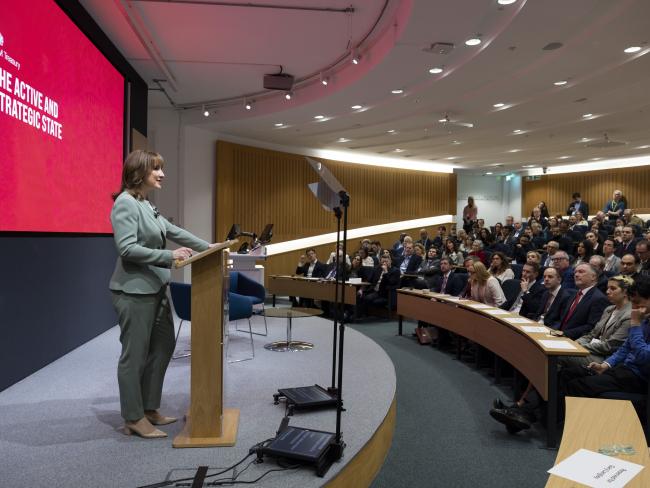
Chancellor Rachel Reeves delivering her Mais lecture in London on 17 March 2026. The “active and strategic state” she championed is designed to enable alignment with the EU. Photo Kirsty O'Connor / Treasury /Flickr (CC BY-NC-ND 4.0).
Keir Starmer is planning to include a measure in forthcoming legislation to allow the government to adopt EU single market rules without a normal parliamentary vote.
The Labour government is negotiating various deals with the EU as part of its “reset”, including food standards, energy trading and youth exchange schemes. It wants to be able to force these through without scrutiny and by-passing any opposition.
Assertion
The Chancellor, Rachel Reeves trailed this move in her Mais lecture to City leaders in March. She called for an “active and strategic state” as a cornerstone of “securonomics”. Exactly what this mans for economic policy is open to question, but it is predicated on the assertion that “Brexit did deep damage”.
The King’s Speech on 13 May will set out the government’s legislative programme. This is expected to include a bill align Britain with new EU regulations in several areas – with new powers allowing so-called “dynamic alignment” with the EU in areas where deals have already been signed.
Without scrutiny
The move is possible under the so-called Henry VIII powers, named after the 1539 law that allowed the monarch to rule by decree. It would allow ministers to approve laws without full scrutiny, using secondary legislation. Parliament can either approve or reject secondary legislation, but cannot amend it.
Such powers will enable the government to fast-track draft laws to align with future EU standards. This is designed to ensure a single market in the trade of goods and services – and could apply to everything from farm products to cars.
The government claims this will promote trade without breaking the government’s supposed “red lines” against rejoining the customs union, rejoining the single market, or returning to freedom of movement.
‘Integration with the EU by stealth…’
But alignment with the EU’s single market is tantamount to rejoining it – “integration with the EU by stealth”. Although Starmer’s moves are not exactly stealthy, this will prevent any questioning of what the EU proposes – for example on gene editing and innovations in food production.
The Labour manifesto for the last election may have ruled out rejoining the EU single market or the customs union, but other measures in the manifesto have already been broken. So the “red lines” may not be an impediment after all.
Labour crows that its aim is prosperity through growth, and like all governments it claims it will cut red tape and unnecessary barriers. Yet EU regulations are if anything even more cumbersome and bureaucratic than the UK’s.