
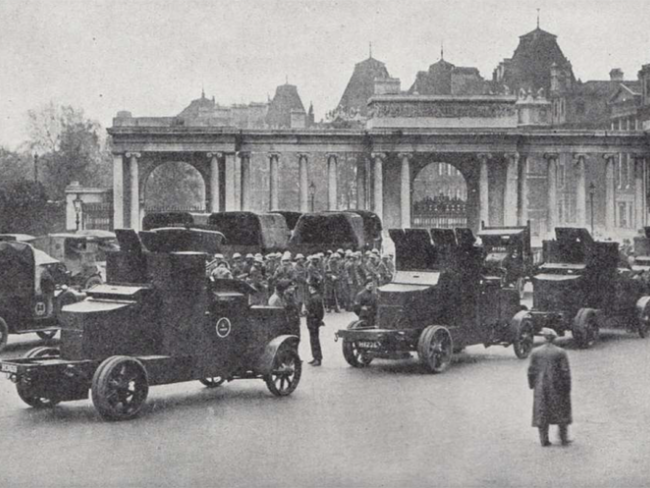
Troops mustered at Hyde Park, London, during the General Strike. Photo Public Domain.
One hundred years ago the General Strike took place in Britain. While marking the centenary, it’s vital to recognise what actually happened…
In trade union history 4 May 1926 is a special date – the day the General Strike started. But it’s important to separate the myths from what actually happened. Above all, it’s often forgotten that the strike was born of weakness, not strength.
In 1914, to strengthen their bargaining hand, the miners had sponsored the formation of a Triple Industrial Alliance with railway and transport workers as a tactic in their fight for pay and conditions. The idea that trade unions should be revolutionary organisations – called syndicalism – was popular before the war and part of the background to this move.
At the end of March 1921 mines, taken over by the government during World War One, were returned to private ownership. Coal owners refused to modernise the industry but immediately announced sweeping wage reductions, imposing a lockout of union members at all collieries.
As happened in 1919 with some success, railway and transport unions again threatened a Triple Alliance strike in support. This time the government responded with a State of Emergency, had machine-guns posted at pitheads and sent troops in battle order to working class areas.
Last-minute negotiations petered out in confusion. Strike action was withdrawn, earning the event the derogatory name Black Friday. The miners resumed work on the owners’ terms.
The 1923 boom in mining allowed negotiation of higher wages, but collapse soon followed. By 1925 coal owners renewed calls for a reduction in wages. The newly formed TUC General Council, in an attempt to displace the Alliance, supported the miners.
The government bought time in negotiations and brokered a deceptive peace with a nine-month coal subsidy. The trade unions, swollen-headed by the effectiveness of their mere threat to strike, thought Prime Minister Baldwin had capitulated, and called the day Red Friday.
But the government – knowing it wasn’t ready – had allowed an armistice in order to gain time for a later assault. It took preparatory action in a strategic, class-conscious fashion. By the spring of 1926, it had stockpiles of food, coal and fuel.
Meanwhile trade union leaders acted as if trouble could be averted. Although the unions had declared war and rhetoric still flourished, union leaders and most of the membership had not apparently really meant it.
The trade unions made no preparations for a national strike until 27 April 1926. The majority of the General Council lacked enthusiasm for action. Unreasoning hope for a settlement was pinned on the Samuel Commission. When it reported unfavourably in March 1926 on the key issues of hours and wages, the miners refused to accept it.
Vain hope
Three weeks of futile negotiation followed. But now the government was prepared and not interested in making concessions. The unions remained ridiculously hopeful of a settlement.
But in the final negotiations on Friday 29 April, mine owners offered a wage cut on worse terms than the Samuel Commission. The government refused to interfere, and brought in an Emergency Powers Act. On 30 April – the day on which the subsidy ran out – mine owners posted notices in most pits. A million miners were locked out.
On 1 May the unions declared they were prepared to hand over their autonomy to the General Council during the dispute (never a wise course of action) and voted to join a National Strike on 3 May. The General Council now deemed the conduct of the dispute to be completely in its hands, either to organise a strike or – increasingly from day one – to arrange a climb-down and call it off.
The “General Strike” was not quite a general, all-embracing strike. It was a partial national strike of some elements. Only sections of the labour movement were called out: railways, transport, iron and steel workers, builders, printers, dockers – between 1.5 and 1.75 million workers. Other trades were kept back.
Critically, the trade unions went into battle unready and with divided leadership. Government was ready though. Departments sent out detailed instructions. All army and navy leave was cancelled.
‘The response to the strike call was overwhelming. Its completeness surprised everyone…’
The response to the strike call was overwhelming. Its completeness surprised everyone including the TUC and the Labour Party, which feared losing “bourgeois” respectability by association. Public transport was mightily affected, especially trains, and trams in London stopped running for the duration of the dispute.
Despite much publicity, volunteers on buses and elsewhere had little effect. But government plans to use road haulage lorries worked – goods were transported around the country by non-unionised labour.
The TUC General Council called off the strike on 12 May. It obtained no terms for the miners or for the other workers who had struck in sympathy with them. The miners continued on strike alone for six months. Eventually they were forced back to work on regional settlements, longer hours and lower wages, with an ever-present pool of unemployed miners to undermine their efforts.
In other trades and occupations, employers sought to inflict setback and sack trade union leaders. Within a year the Trades Disputes and Trade Unions Act was introduced, forbidding sympathetic strikes and mass picketing. TUC membership fell from 5.5 million to 3.75 million by 1930.
Tactics and strategy are the lifeblood of our class. Properly understood, a general strike is a potent political weapon reserved for when a working class is ready to overthrow the exploiters’ system and seize the levers of power. Unless such a level of understanding is there, a general strike should not be broached. Other more irregular tactics should apply.
• This article is based on a longer, more detailed analysis published in Workers in November 2011 and available online – and just as valid now as it was then.
• The General Federation of Trade Unions is marking the centenary, in partnership with the Working Class Movement Library and other similar organisations. Go to generalstrike100.com for an interactive map of events taking place.