
23 April 2026
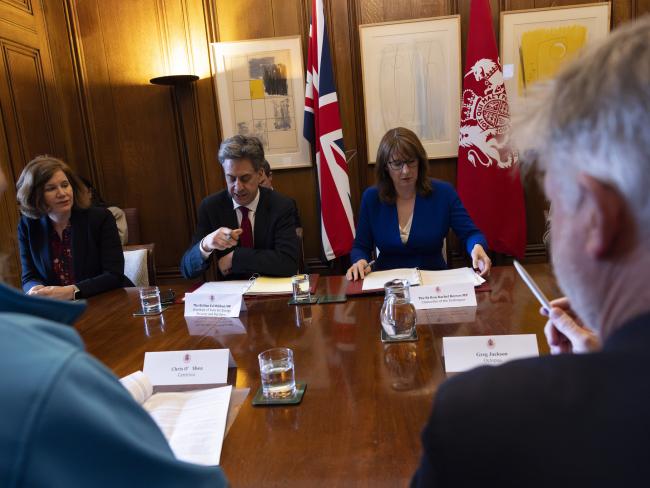
Energy secretary Ed Miliband at an energy roundtable hosted by the Chancellor Rachel Reeves on 26 March 2026. Was he not listening, or were critical voices not invited? Photo Kirsty O'Connor / Treasury / Flickr (CC BY-NC-ND 4.0).
On 15 March this year, in light of the disruption to fuel transport in the Strait of Hormuz, energy secretary Ed Miliband issued a press release detailing measures to ensure British energy security. It could have better been issued on April Fools’ Day.
Top of the list comes the news that you will soon be able to pop to a nearby supermarket and buy “plug-in” solar panels for your balcony or garden, notwithstanding that gardens and balconies are not like rooftops, but rather are shaded for much of the day.
Meanwhile, for those millions without a balcony or garden, or who are reluctant to deface their outside space with these hideous structures, not a mention.
Incentives
Next comes a promise to bring forward the annual renewables auction to July, offering companies ever-growing incentives to invest in our energy with guaranteed returns regardless of market conditions.
And finally, the promise that despoliation of the countryside and sacrifice of quality farmland will be accelerated – so that renewables infrastructure can be rolled out even faster.
‘There are calls from all quarters for the government to abandon its destructive net zero crusade.’
There are calls from all quarters for the government to abandon its destructive net zero crusade –from company directors increasingly drawing back from electric vehicle commitments, from unions witnessing the decimation of urgently needed manufacturing jobs and urging further use of the vast North Sea basin, from farmers concerned about our growing dependence on food imports, from local people faced with giant wind and solar installations despoiling the countryside.
Yet Miliband seems unable to appreciate the folly of his ways. Or perhaps he genuinely believes the fairy tale of renewables replacing fossil fuel generation. Whether mistaken or deliberate, the consequence for Britain is the same, industrial suicide.
Challenge
Here’s to more voices like that of Steve Davison, whose “Baffled By Science” Substack articles regularly challenge the prevailing net zero orthodoxy.
His post – from 1 April, but no joke – exposes the nonsense at the heart of this policy. There are echoes of Lewis Carroll’s Through the Looking Glass, in which the White Queen tells Alice that believing impossible things was simply a matter of practice.
Davison says, “Like most adults, I stopped believing in fairies and Father Christmas a long time ago. Unfortunately, many of our politicians seem unable to throw off their childhood fantasies. Ed Miliband is the prime exemplar of his class.
“It is astonishing that someone in charge of energy policy can have so little understanding of his brief.”
“It is astonishing that someone in charge of energy policy can have so little understanding of his brief. It does not help that he is surrounded by people who reinforce his beliefs, in a supercharged echo chamber, formalised in the form of the Climate Change Committee.”
It is more and more necessary that science prevails over the nonsense which passes for government policy – and that more people speak up against such nonsense.
Let’s call this what it is: a subterfuge whose only purpose is to camouflage the acquiescence of this and previous governments in the wholesale rundown of Britain.
Ten impossible things
Here is Steve Davison’s list of the ten impossible net zero things that you must believe to support decarbonising our economy at breakneck speed.
- Reducing our CO2 emissions will reduce global temperature despite accounting for less than 1 per cent of global emissions.
- Offshoring our manufacturing (and its emissions) will not destroy jobs, particularly in high skilled offshore, steel, aluminium and car-manufacturing sectors. Or green jobs will replace these jobs despite most renewable technology being made in China.
- We can close down all fossil fuel generation despite electricity only accounting for 20 per cent of energy use and being vital to maintain grid security during long gaps in wind and solar generation. Essentially, we need to believe that new physics and economic models can fill the gap, along with massive investments in grid infrastructure and/or carbon capture and storage.
- Battery storage will replace fossil fuel generation and imports, despite the environmental, economic and engineering challenges of delivering grid scale storage that covers many days. None of these challenges have been solved yet but they will be any day now.
- Renewable energy is the cheapest energy available – as long as we ignore the massive public subsidies. Just give them long enough and somehow the subsidies will come down, despite having gone up again in AR7 (the latest Contracts for Difference allocation round).
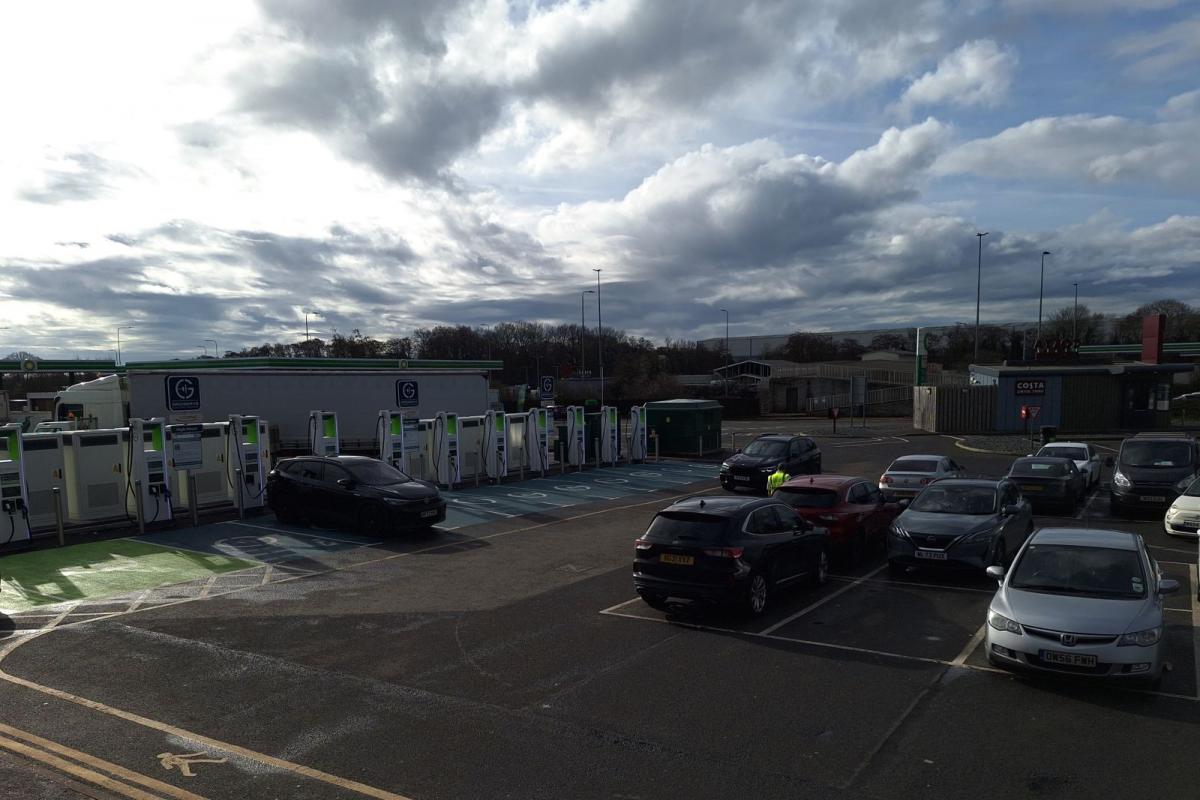
- We will all switch to EVs despite half of us not being able to charge at home and the technology being unsuitable for commercial use, such as road haulage. We also need to ignore stagnant sales, plummeting residual values, safety concerns, an electricity grid creaking at the seams, and the cost of replacing batteries.
- Covering agricultural land with turbines, solar panels and batteries is a price worth paying despite the loss of home grown food production and increased reliance on imported food, along with their extra emissions. It is even worth destroying our peat uplands and losing their massive potential as carbon sinks.
- Energy security can be managed by importing oil, gas and electricity whenever we need it, despite what goes on elsewhere in the world and that prices are set globally, despite the fact that US energy prices are much lower than ours.
- We can ignore the thousands of things, other than energy, which rely on oil for their existence, including: clothing, medicines, plastics, synthetic rubber, lubricants and fertilisers.
- The astronomical costs, both economic and societal, are a price worth paying, despite all of the above.
Thanks to Steve Davison for permission to quote his article.