
23 February 2026
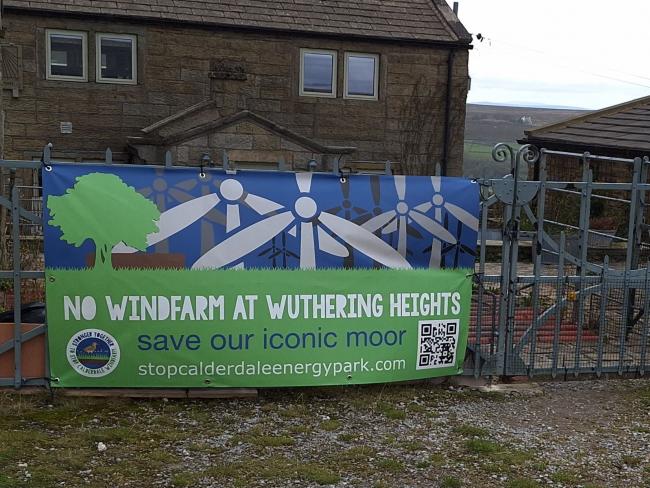
One of many banners around Haworth campaigning against the proposed Calderdale Energy Park – a huge wind farm – which would wreck the famous moorland landscape. Photo Workers.
The reality behind the uncontrolled drive for solar and wind energy is the destruction of productive farmland and damaging valuable moors. And consumer bills will rise to pay for this.
On 10 February, energy secretary Ed Milliband awarded subsidies to 134 new solar farms across England, including the huge West Burton on the border between Lincolnshire and Nottinghamshire.
Good farmland
He also approved 23 others in Wales and Scotland. These solar farms would cover a total of over 40 square miles, mainly like West Burton they are on good farmland.
Miliband also approved 28 large wind farms, including the Imerys Wind Farm in Cornwall, England’s largest onshore wind project in a decade. (He removed the de facto ban soon after taking up office.).
‘Campaign groups are fighting hard against the proposals.’
But at 20 megawatts, Imerys is small by comparison to others planned in the Pennines – like Scout Moor 2 (100 megawatts) and Walshaw Moor (302 megawatts). But Miliband isn’t getting it all his own way. Active campaign groups are fighting hard against the proposals on several grounds.
Profit
Opponents of Scout Moor point out that development only happen if there’s a substantial profit – and that’s not the best way to plan energy supply. The objectors to Walshaw emphasise that the installation will damage deep peatlands, a valuable carbon sink.
And turbines up to 200 metres high will destroy the wildness of the moors made famous by the Brontë sisters’ novels. Walshaw (now renamed Calderdale Energy Park) has been scaled back – for now. The campaign group is not giving up the fight though.
Disguise
Calling these installations “farms” or “parks” cannot disguise that they are industrial installations. Rosie Pearson, chair of the Community Planning Alliance, said solar production, “represents further destruction of countryside and best farmland while warehouse roofs, car parks and houses sit empty of solar panels.
“Add that to the pylons that accompany the solar farms and rural areas are being industrialised. We see once again that food security, nature and landscapes do not matter to Miliband.”
‘The scheme bad for the environment and also bad economics.’
Not only is the scheme bad for the environment, it is also bad economics. Miliband has to bribe companies to invest in these projects by giving them subsidies, funded by us, the captive consumers.
Guaranteed price
In the Contracts for Difference scheme, the companies running these projects will get a guaranteed minimum price for the power they produce for two decades after they switch on.
New solar farm operators will get a minimum price of £68.17 per megawatt hour. New onshore wind farms will get a minimum price of £75.50. Both are far higher than the £60 per megawatt hour that markets currently price for electricity.
Consumers would make up the difference. The Office for Budget Responsibility last year warned that levies on consumer and business bills would rise from £2.3 billion in 2024-25 to around £5 billion by 2030-31.