
1 December 2025
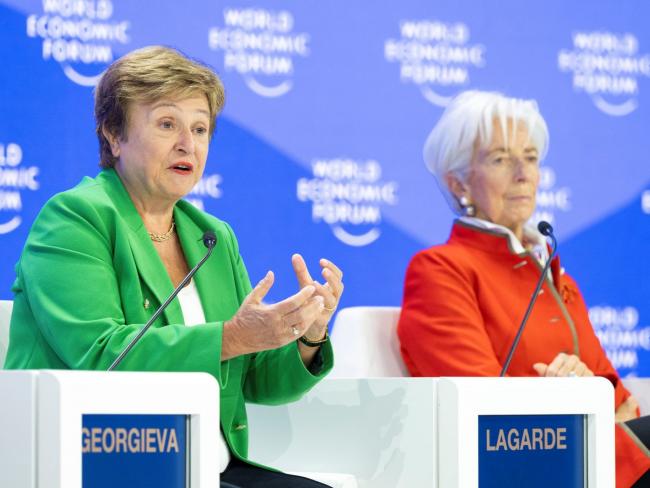
International capitalist institutions are closely connected. Current IMF head Kristalina Georgieva at the World Economic Forum in Switzerland, January 2025. Alongside is her predecessor Christine Lagarde, now European Central Bank president. Photo World Economic Forum / Thibaut Bouvier via Flickr (CC BY-NC-SA 2.0).
The International Monetary Fund (IMF) is central to the way finance capital runs. It’s instructive to examine how it controls the international capitalist economy through debt.
The eventually victorious allied nations of World War 2 established the IMF in 1944. This was in reaction to the great depression of the 1930s and one of several measures aiming to consolidate peace and help war-ravaged Europe to rebuild.
Weapon
Headquartered in New York, it rapidly slipped out of joint control and became effectively a weapon used by western powers, primarily the US. It helped build and maintain a dictatorship of finance capital in the post-war world.
‘IMF intervention systematically undermines national sovereignty.’
IMF intervention in supposedly sovereign nation states has systematically undermined that sovereignty. It has dragged control of national economies into the hands of transnational finance capital.
To achieve this, it lends money when (capitalist) countries need it most. And then, like the best of dealers, the IMF keeps its junkie-like borrowers supplied without ever allowing them to break the habit.
Top of the list of nations in debt to the IMF and tied to transnational capital is Argentina, which owes $57 billion (as of October 2025). This is more than the total owed by seven medium-sized countries.
Dependency
Argentina has a long history of IMF debt. At times it has boldly deferred repayments in such a way as to prove that the emperor is, not quite naked, but is at least extremely underdressed. At other times, as now, it descends into almost total dependency.
As well as the IMF loans, the present Argentine government seeks support from the US in return for economic austerity policies urged on it by Donald Trump.
Ukraine
Next on the list is Ukraine: it has managed to accrue a $14 billion debt in a relatively short time. It is a country borrowing way above its means with virtually no prospect of ever getting free of the IMF and its capitalist rules.
Ukraine is now bound well and truly into the mainline of finance capital. It joined the IMF in 1992 and at every stage since – 2008, 2014 and 2022 – increasing foreign interference has gone hand in hand with greater dependency on the IMF.
Ukraine is far from independent; it’s entirely in hock to transnational finance. Its IMF credit stands at 6.74 per cent of the country’s GDP, way above any other major debtor apart from Argentina
Trapped
All of the other eight of the top ten countries are trapped long-term as they have tried to fund development by going into debt: Egypt, Pakistan, Ecuador, Ivory Coast, Kenya, Bangladesh, Ghana and Angola.
More revealing is the list of countries not among the IMF’s major debtors: these are the countries over which international finance has least control. Russia isn’t on the top ten debtors list, and neither of course is China.
Socialist countries
Socialist countries trying to build economies independently of western control such as Cuba and North Korea don’t appear either. The “axis of evil” then turns out to be the axis of those countries who refuse to go into debt to the IMF. Understood in this way, NATO and its targets for war make a lot more sense.
And Venezuela, which tried to use oil wealth to escape the clutches of the US and dollar domination, owes nothing to the IMF. Yet because of the dire state of its economy and its past temerity, Trump wants to rule the roost in Venezuela and return it to a state of dependency – by force if necessary.