
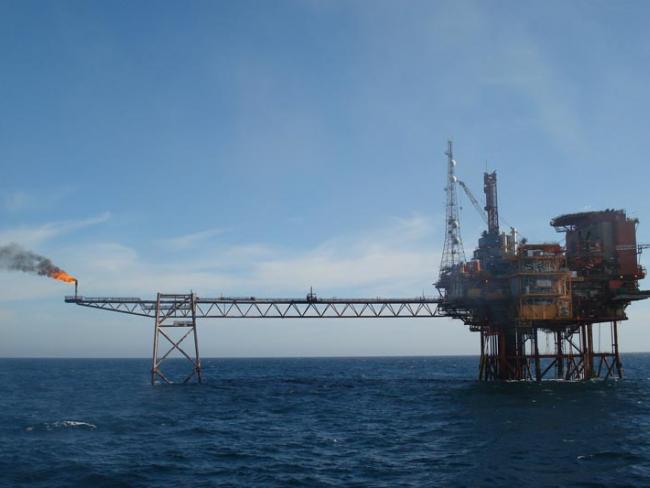
Oil platform in the Montrose Alpha field, in Britain’s sector of the North Sea. Output from Montrose Alpha began in 1976. A major upgrade in 2017 assured oil production up to 2030. Photo Lee181169 (Public Domain).
Britain relies on oil and gas for around three-quarters of its energy – a level that has hardly changed in decades. We will be relying on oil and gas for the foreseeable future, as the Climate Change Committee says…
Britain cannot do without oil and gas. Even though oil and gas production is forecast to be cut from 74 million tonnes in 2022 to 33 million tonnes by 2030, these 33 million tonnes are still needed. Even on government projections, oil and gas will meet a fifth of our needs in 2050 – the year when the government aims for us to have net zero carbon emissions.
Yet successive governments have chosen to import energy rather than produce it. Energy secretary Ed Miliband has gone even further by banning all new drilling and all new exploration for oil and gas.
Not a single exploration well was drilled in British waters last year – for the first time since 1964. But Norway, which shares the North Sea basin, drilled 49 exploration wells last year, making 21 new discoveries in the process.
Miliband has imposed effective marginal tax rates of over 100 per cent on some companies. As Offshore Energies UK says, the 78 per cent flat rate total tax imposed on oil and gas profits is driving companies away.
Missing out
The results? A recent study from the Parliamentary Office of Science and Technology looked at areas known to hold oil and gas resources, but which Miliband has refused to license for drilling. It found that Britain will miss out on more than 4.6 billion barrels of oil and gas under Labour’s ban on new drilling.
Britain imported last year 42 per cent more liquefied natural gas than in 2024. This has higher emissions and is four times worse for the environment than our domestic gas from the North Sea. And this imported gas comes mostly from the USA: its transport adds yet more to emissions.
This government policy means squandering £50 billion of the previous investment in the North Sea. And Britain becomes less energy secure.
Offshore Energies UK, the trade body for Britain’s oil and gas industry, says that there are 51 gas fields in our waters, including the Glendronach and Glengorm fields, plus 60 possible extensions to existing fields. They could provide a total of 3.25 billion barrels of oil equivalent (BOE).
The North Sea Transition Authority’s latest Reserves and Resources report, published in October 2025, estimates proven and probable UK oil and gas reserves at 2.9 billion BOE at the end of 2024.
Contingent resources – petroleum estimated to be recoverable from known deposits, but not ready for commercial development – stand at 6.2 billion BOE. Prospective resources – undiscovered potentially recoverable resources in mapped leads and prospects yet to be drilled – are estimated at 4.6 billion BOE.
There are also potential gas fields onshore, like the one discovered last year under Lincolnshire. This could provide 480 billion cubic metres of gas, enough to meet the country’s total gas needs for seven to ten years. But this can only be extracted by hydraulic fracking – which Miliband has also banned.
Two important North Sea fields, as yet unexploited, are Rosebank and Jackdaw. Together these two fields could produce up to 2.3 billion cubic metres of gas per year.
Rosebank, a reserve 60 miles west of Shetland, is buried 5,200 feet beneath the seabed – and the largest undeveloped oil and gas field in British waters. When in opposition, Miliband described its possible exploitation as “climate vandalism”.
Gas ready to come
Jackdaw, a joint venture between Shell and Equinor ASA, the state-owned Norwegian oil company formerly known as Statoil, lies 150 miles east of Aberdeen. It has already been partly drilled. If Jackdaw is approved, its gas could enter Britain’s gas network this year, according to the venture’s boss Neil McCulloch.
Jackdaw could provide 6 to 7 per cent of our production, enough gas to heat 1.4 million homes – increasing reliable supplies and helping to cap costs. Campaigners against oil and gas exploitation are again gearing up their opposition and challenging those figures.
Boris Johnson’s government granted Equinor permission to drill at Rosebank. But the Scottish Court of Session overturned that decision in January 2025. The court also blocked production at Jackdaw.
‘Successive governments have chosen to import energy rather than produce it…’
On 23 March, Unite oil and gas workers launched “Keep the North Sea Working”, a campaign demanding protection for jobs and for the communities those jobs sustain. Current policies are destroying 1,000 skilled, productive jobs a month. Unite general secretary Sharon Graham said, “The government’s energy policies in Westminster and Holyrood are putting jobs and energy security at risk. Blocking oil and gas production in the North Sea, especially now, is an act of monumental political self-harm.”
People across Britain generally agree that we should develop our energy resources. A nationwide survey of 2,000 people, conducted 10-13 March by Opinium on behalf of Offshore Energies UK, found that 76 per cent agree that “because global events can disrupt energy supplies, the UK should continue producing oil and gas at home rather than relying more on imports.”
And around 40 per cent believe the best approach to our energy security is investing in a balanced mix of renewables and fossil fuel. Just 26 per cent want a renewables-only approach, and 13 per cent want oil and gas only.
Offshore Energies UK CEO David Whitehouse commented, “The public are clear – the UK needs homegrown energy and a balanced transition that strengthens our national security.”
Even RenewableUK, which represents 500 companies in Britain’s renewable energy industry, has called on Miliband to “take energy out of the culture wars” by increasing North Sea production of oil and gas.
Tara Singh, their chief executive, said, “Britain will be stronger, safer and less exposed if it produces more home-grown energy of every kind…Let’s start with gas. However fast we build clean power, Britain will still need gas well into the foreseeable future: to heat homes and power industry where electrification doesn’t make sense for households and businesses and to help keep the electricity system balanced. So it is entirely sensible to support continued domestic oil and gas production in the North Sea. If we do not produce that gas here, we will still need it. We will simply import more of it.”
The EU’s Green Deal?
The Prime Minister wants “deeper economic integration” with the EU, to be achieved this year. He wants to give control over our energy policy to the EU, and to firm up his government’s net zero targets.
Starmer embraces the EU approach of prioritising net zero over industry. He wants “the dynamic alignment” of British law with EU rules on “the promotion of renewable energy”. This could force us to decarbonise across the board – not just electricity, but also heating and transport – and far more quickly than we have done so far. That is an EU takeover of Britain’s energy policy, not a realignment (see Box).
“The UK needs homegrown energy and a balanced transition that strengthens our national security…”
Starmer’s government wants Britain to rejoin the EU’s internal electricity market and align with EU’s wholesale and retail electricity market rules. Britain would be bound by these rules, with no say over them. Under a legally binding financial mechanism, Britain would never stop making payments to the EU.
Professor John Constable of the University of Austin, an expert on Britain’s renewable sector, said the deal was “fundamentally political”. He said, “I fear that the Labour Government is trying to poison the well for any incoming government. It will be a poisoned chalice – they will be so fettered by EU law, and it will be incredibly difficult to unwind.”
Chancellor Rachel Reeves is on record in support of North Sea drilling because of its positive effect on “jobs and tax revenue”. The SNP’s John Swinney echoes her. When politicians start to talk sense, you just know that elections are coming soon.
The choice
The economic choice facing us is – do we stay committed to net zero or do we rebuild industry after a period of economic destruction? A recent paper from the Great British Business Council think tank sets out the choices in detail.
We need to repeal the 2008 Climate Change Act, which forces us to subordinate energy security and affordability to the pursuit of net zero. We should scrap the UK Emissions Trading Scheme, which makes oil and gas more expensive than renewables. And not join the equivalent EU scheme either!
As the world becomes increasingly volatile, the need for Britain is to prioritise our energy and our industrial resilience.
Britain needs more investment in gas storage capacity. Strategic gas stocks amount to at most only 2 per cent of annual usage (Germany stores about a quarter of its annual usage). When Centrica closed the Rough storage facility, this government washed its hands of the problem, saying that it was a commercial decision.
Invest in sovereignty
Britain need to invest in developing energy sovereignty in order to revive industry. Government should impose an export ban on all current and future oil production in British waters, keeping British oil solely for British domestic use. Our oil should be priced in British pounds not in US dollars, priced to serve the needs of British industries and British households.
Successive governments have misdirected far too much of our money into futile attempts to be relevant militarily in the Middle East and Eastern Europe, rather than investing in what we actually need to defend our country. Energy independence is vital for our national security. Without energy independence, we are at the mercy of foreign suppliers.
• Related article: EU: what’s in a name?